

Many women, particularly those from African and Caribbean Diaspora communities, grow up receiving subtle and overt messages that our value depends on how well we meet expectations, care for others, and prove ourselves. Over time, these messages can become the voice we use when speaking to ourselves.
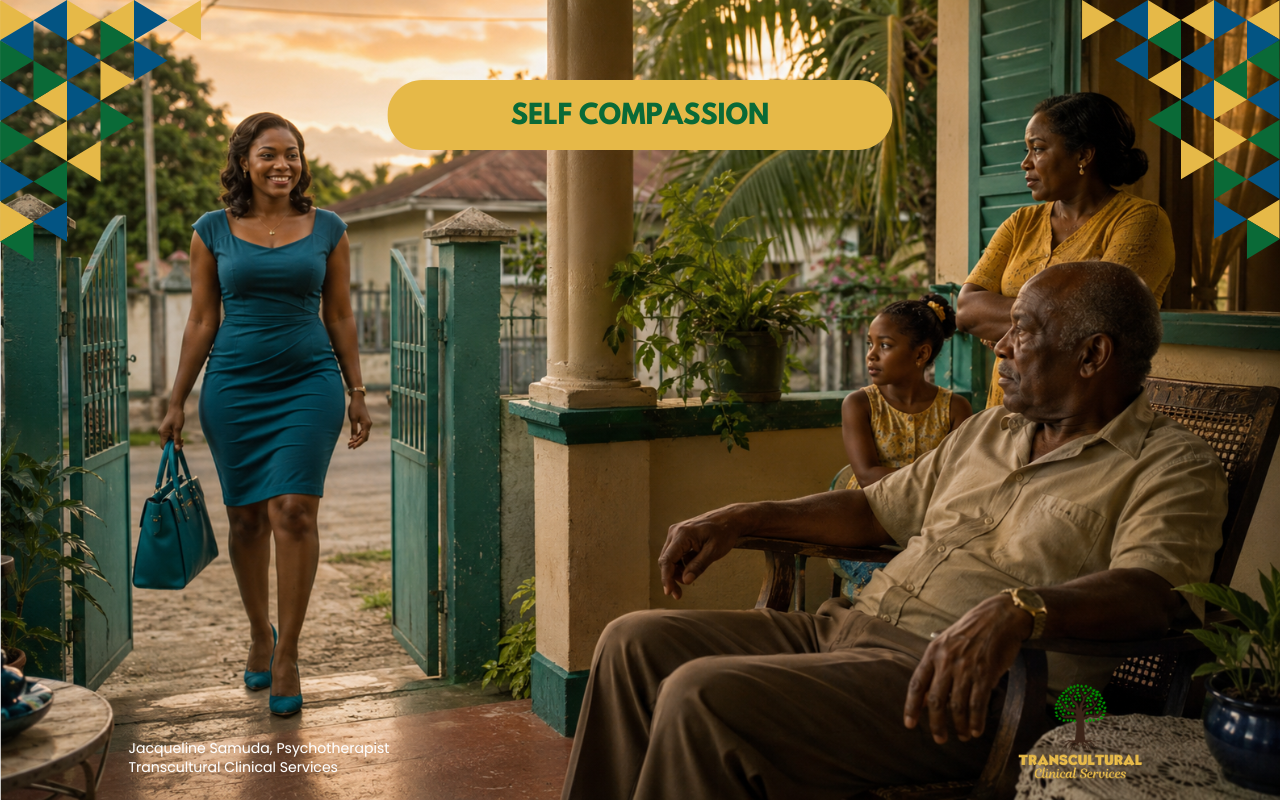
“Hello, Uncle Joseph. How are you doing?” Joyce, my young cousin’s exuberant voice filled the air. Her smile beamed bright as she opened our front gate at Nugent Street.
I had not seen Joyce since she left Jamaica and went to study nursing in England. Via my aunt, I knew Joyce was doing well in her studies.
My cousin appeared happy and healthy as she rushed towards the veranda where my father and I were seated, enjoying the cool evening breeze.
Joyce was sporting a stylish handbag that matched a dress whose material strained across her hips. It was clear that Joyce had put on some weight since we last saw her.
My father’s first greetings to Joyce were not about how well she had managed living alone in England away from her parents, or her adaptation to a new culture, or even how well she had progressed in her nursing studies throughout the last two years.
They were about the increased weight she carried on her once slender frame. “You should reduce!” You should reduce!” My father repeated.
Joyce did not respond to my father’s comments about losing weight, and her openness and the light in her face dimmed.
Even though I was probably about 8 or 9, I felt her embarrassment keenly.
“It’s good to be back in J.A,” Joyce said before cutting her visit short. “I have so very little time in Jamaica and so many relatives to visit,” she said as she turned around and headed out the front gate.
What stayed with me was not simply my father’s comments about Joyce’s weight. It was how quickly my cousin’s joy gave way to self-consciousness. Before acknowledging Joyce’s courage and accomplishments and bravery while living abroad, my father had focused on what he perceived as needing correction – her weight.
For women, experiences like these are common.
Many of us internalize these messages long after the moment has passed. They teach us to ignore our strengths and accomplishments and that criticism is a normal way to motivate change.
We wrongly believe that being hard on ourselves is the way we become better.
The words spoken by others become the words we repeat to ourselves. Instead of offering ourselves understanding when we struggle, we respond with the same criticism we once received.
Why should we show ourselves self-compassion in speech and deed?
-
Self-compassion challenges our inherited beliefs;
-
Self-compassion reminds us that making mistakes, struggling, and hurting are a part of being human;
-
Self-compassion helps us respond to setbacks. By showing kindness towards ourselves, we are more likely to recover faster, adapt, and persevere;
-
Self-compassion can allow us to acknowledge mistakes, without turning our poor decision into a judgment about our self-worth;